Freedom Force Interview
Interviews
|
Freedom Force Interview Developer: Irrational Games |
|
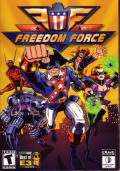
Interview with Jonathan Chey, Project Manager & Lead Designer, Freedom Force, Irrational Games Australia
1) How did you get involved in the gaming industry, and why?
Actually, it was an accident. After I finished grad school I was head-hunted by Looking Glass Studios (makers of Thief & System Shock). I had never thought about the gaming industry and was going to go do some boring consultancy work but LG was very persuasive. In retrospect, it was one of the luckiest things that has happened to me.
2) How did Freedom Force evolve into what it is now, and what are future plans for the game?
Freedom Force was an idea that we came up with several years ago. Originally it was thought of as very much like X-Com, that is, it had a complex strategic layer in which you managed your team, built a base and responded to events happening on a large scale strategic map. Also, it was turn-based and set in a highly accurate representation of New York.
Since then, it has become much more story and character oriented and much less focused around micro-management. I’m very happy that we’ve managed to retain a lot of the tactical interest of the game whilst also being able to open it up and make it a lot more accessible than it would have been as originally conceived.
In the future, we are planning to expand the franchise in several directions. Obviously, we will be adding new content to the existing game (expansion packs), also we’ll be working on a sequel that adds new features and we’ll also be looking at console versions. The sequel will be the product that “moves the story forward”. We’ve always intended to advance the characters in time but also to reinterpret the game in terms of the way that comic books have progressed. So Freedom Force was set in the Silver Age of comics, but Freedom Force 2 is likely to be set in the 70s and so on.
3) What is your personal favorite genre of games, and why?
I love tactical combat games like Myth and X-Com but I’m also a big fan of strategy games like Civilization. Oh, and then I love first-person games and role-playing games and… I guess I like anything so long as it is well done.
4) How do you see the industry changing in the future, i.e. with console games becoming more prevalent, consumer demands, faster and more detailed technology coming out, etc.
There was a lot of talk a year ago about how the PC games industry was dead. This is a cyclical topic that comes up whenever a new batch of consoles come out. I think it’s pretty clear that the PC offers unique advantages that haven’t been superseded by consoles yet so I think it’s going to be around as a platform for many years to come.
As for new technology, I don’t think I have any unique insights other than the usual new graphics and input devices that people are always waiting for. I do hope that the increased CPU power that we will have available is used for something other than just better graphics. Better physics and AI simulations are very high on my list of things I want to see.
5) In relation with games and media transitions, (for example movies turned into games, comic books turned into movies, then games, and vice versa) how do you see this affecting the industry both positive and negative?
I think it can be a positive thing if handled well. Everyone hates the cheap knock-off games that are put out with a big movie and the crappy movie versions of games are a waste of time too. Properly handling a transition from one medium to another requires careful thought, in particular, games and film are very different forms.
Freedom Force was problematic because comics and games are perhaps even more different. One is a static 2D narrative form and the other is 3D and interactive. I don’t think I can claim that we did a perfect job in interpreting our source material, but we worked hard to understand what core elements of the source could be appropriated, what could be re-interpreted and what were not reproducible.
Done right, I think this kind of cross over is a valuable tool for getting mind-space for new games products. Done wrong its just a waste of time.
6) What were some of the challenges you faced in creating Freedom Force?
Technology is always a challenge. Freedom Force was particularly tricky because it was the first project done in our new Australian office so we had a lot of teething problems. And because we are trialing some new gameplay and UI ideas there was a lot of trial and error getting things right.
Overall though it was far from the most problematic title we’ve worked on…
7) Are there plans for Freedom Force to be released on console platforms such as playstation 2? Why? (either yes or no)
These plans are in discussion right now. I expect there will be a console version, though which platform or platforms it will be on is to be determined. Also, the console version is likely to be substantially different in terms of UI. We don’t believe in porting PC products straight to console without figuring out how to adapt them.
8) In what ways do you see Freedon Force differing from other games of its genre? Why do you personally think it is unique?
I guess from a content point of view, Freedom Force differs from other comic-book based games in that its gameplay is based around the notion of managing a team of superheroes, not just fighting your way through levels with a single character. Also, we’ve introduced role-playing dynamics so that you can manage and recruit new characters. And then there’s the whole custom character thing which is a first for the genre I think.
From a game genre point of view, Freedom Force obviously differs from other role-playing games in its subject matter. And I think the custom character and power creation system is a step forward in terms of user customization.
9) In relation to how games are becoming more violent and graphic, why do you think Freedom Force can hold its own?
More is not always better. More blood, more gore and more gibs don’t necessarily make a better game. Enough said.
10) What genre would you classify Freedom Force under such as rpg, action adventure, etc. Why?
It’s a tough question. Irrational games usually cross boundaries. This creates some confusion for marketing folks and those who want to classify our games. Freedom Force is a tactical combat game with light RPG elements and a strong story. Is that good enough?
And a few fun question you don’t have to answer if you don’t want to:
1) What is the WORST interview question asked of you?
“So tell me what this game is about.” (asked by someone who doesn’t care)
2) What is the one question, either through interviews or through gamers, that you wished you NEVER had to hear again?
“When are you going to do System Shock 3?”. Actually, I don’t mind the question, I’m just getting sick of hearing it.
3) What do you think was the funniest blooper to occur while creating Freedom Force?
It wasn’t a bug but it was pretty cool when we had sounds speeding up or slowing down with game time… Manbot marching across the map at double time was pretty funny. We also had a cool feature where you could grow or shrink characters with the +/- keys. Timemaster wasn’t nearly so intimidating at 6 inches high…
3) Are there any easter eggs in Freedom Force? Care to share?
There’s a basketball in one of the levels. This has special meaning to those who have played System Shock 2…
4) If you could create a game without having to worry about time lines, economic restrictions, etc., what would be the ultimate game for you?
Right now, I’d like the time and money to do the ultimate superhero simulator. Every costume, every power, every animation all totally customizable and configurable…
System Requirements:
Windows XP, Windows Me, Windows 2000, or Windows 98 (Windows 95 and Windows NT not supported)
* 300 MHz Intel Pentium II or AMD K6-2 processor
* 96 MB RAM
* 4x CD-ROM/DVD-ROM drive
* 31 MB free hard disk space plus space for saved games (with additional space required for Windows swap-file and DirectX 8.1 installation)
* 16 MB Direct3D capable video card using the NVIDIA GeForce3, NVIDIA GeForce2, NVIDIA GeForce 256, NVIDIA Riva TNT2, NVIDIA Riva TNT, ATI Radeon 8500, ATI Radeon, ATI Rage 128 Pro, ATI Rage 128, PowerVR3 Kyro II, PowerVR Kyro, Matrox MGA-G450, or Matrox MGA-G400 chipset with DirectX 8.1 compatible driver
* DirectX 8.1 compatible sound card
* Keyboard
* Mouse