Thief II: The Metal Age
|
Review Thief II: The Metal Age Developer: Looking Glass Studios |
 |
THIEF 2 is one of the very best adventure games I’ve ever played. The only trouble is, it’s not an adventure game.
THIEF 2 is one of the very best role-playing games I’ve ever played. The only trouble is, it’s not a role-playing game.
THIEF 2 is easily the best action game I’ve ever played. But it’s not exactly an action game, either.
Then what the heck is THIEF II: THE METAL AGE? I’ll tell you. It’s what can happen when a remarkably talented group of game designers decide to become unfettered by the safe conventions of game genres. It’s also what can happen when a studio truly listens to the fans when planning changes for a sequel to a popular game.
When first released at the end of November 1998, the original THIEF: THE DARK PROJECT wowed the critics by turning the conventions of the first-person shooter on its head. Even though it was built with the structure of a shooter, the point in THIEF was to avoid confrontation. Your protagonist, Garrett, had many talents at his disposal, not the least of which was the ability to become almost invisible if his shadowy hiding place was dark enough. Your goal was to avoid confrontation, to achieve your goals by stealth and finesse.
The game drew a lot of attention from adventure gamers because of its strong story and lack of blood-and-guts violence. I was a huge fan of the game, but felt the designers lost their nerve in the last act, when the story devolved into a much more traditional “kill the monsters” action game.
The talented Looking Glass Studios team went back to the drawing board for the sequel, which was released in February 2000. The first big favor they did for the fans of the first game was to greatly diminish the time spent fighting monsters and various types of undead. In Thief 2, you’re almost always sneaking around environments populated by actual humans and their security devices.
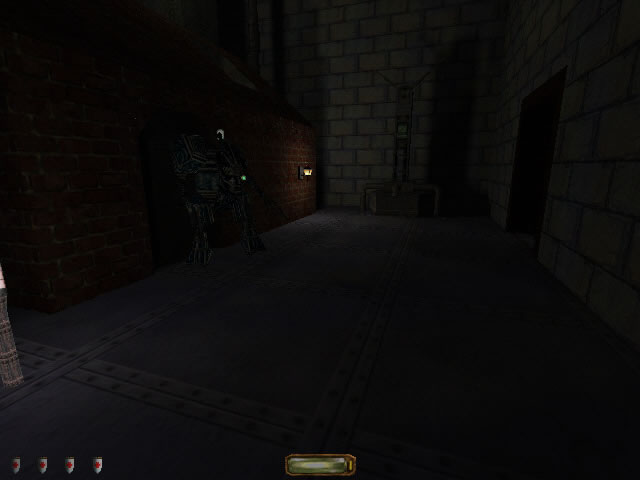
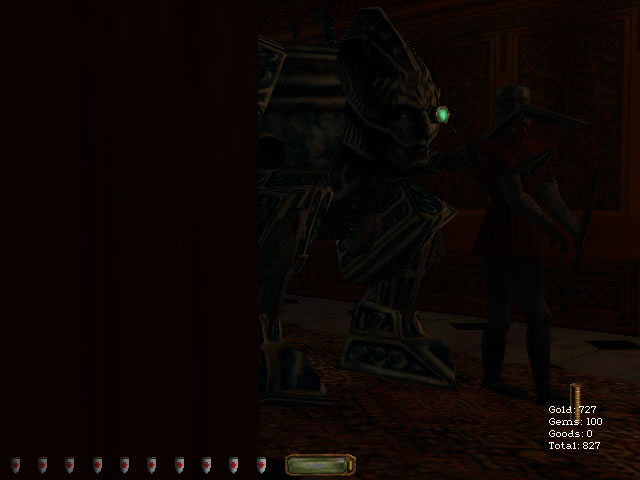
Once again the main character is the world-weary superthief Garrett, whose talents always seem to lead him into trouble. Once again the story takes place in a mysterious unnamed city, a curious place where medieval style and architecture live alongside growing technological improvements. The events of the first game are not too long past, and the dominant religious group The Hammers have been reduced to a powerless remnant. The first few missions of Thief 2 serve as a sort of warm up to what’s coming: helping a pair of young lovers get together, and sneaking around a dockside warehouse. Soon, however, the plot begins to insinuate itself. There’s a new influence in town, and it’s the Mechanists. The Mechanists install all sorts of devices that make Garrett’s job harder: electric eyes, primitive robots, and even creepy androids.
Once again the genius of the game is in the gameplay itself. A small green jewel at the bottom center of the screen shows you how well protected you are by shadow. A bright green jewel and you’re exposed, baby. A dark jewel and you’re virtually invisible.
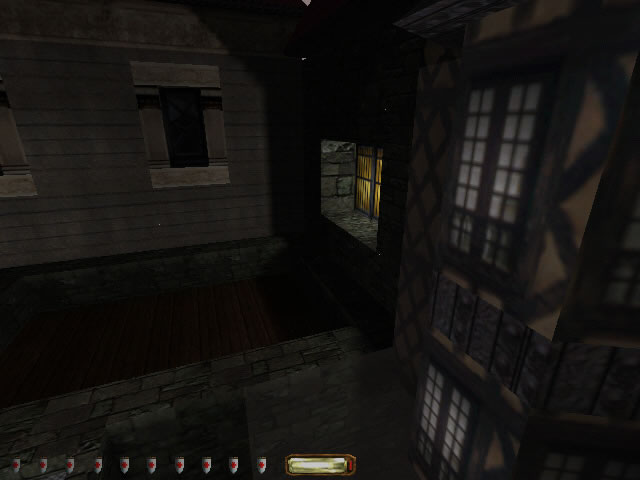
This is a game you play with your ears as much as your eyes, and the sound design in Thief II is simply as good as I’ve ever experienced in a game (the only other games in its class in the sound department are Thief and Deus Ex). The sound element adds a thrillingly realistic element to the proceedings. You’ll find your heart in your mouth as you stand flat against a wall, listening as the guards footsteps approach. Will he be looking your way? Will you have a chance to knock him out?
I don’t think I’ve played another game in which the vicarious thrill of the experience was any more real. When you finish a mission in a Thief game, you feel like you’ve accomplished it physically.
Now let me address some of my bald statements from the beginning of this piece.
Of course Thief 2 is not an adventure game in the traditional sense. But if you think of an “adventure” as a game in which there’s a very strong backstory, plot, puzzles, mysteries, intrigue, and even character interaction, then you could think of Thief 2 as a rip-roaring adventure. The story of the game is richer, more exciting and more imaginative than the story of most “pure” adventures that I’ve played in recent years.
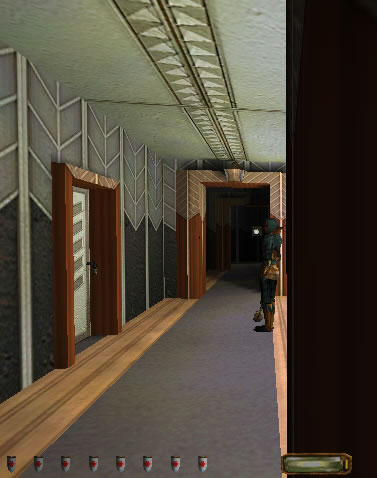
Of course Thief 2 is not a role-playing game. There are no character stats or level-ups, no experience points, no character creation at all. But if you think of an RPG as a game that lets the player decide how to approach and solve problems, you might be surprised how RPG-like Thief 2 feels. The environments in each mission are huge and diverse, and there are frequently more than one way to achieve objectives. This flexibility is at the heart of many good RPGs.
So what the heck is Thief 2, anyway? Technically it’s an action game with elements that make it far more interesting than most action games.
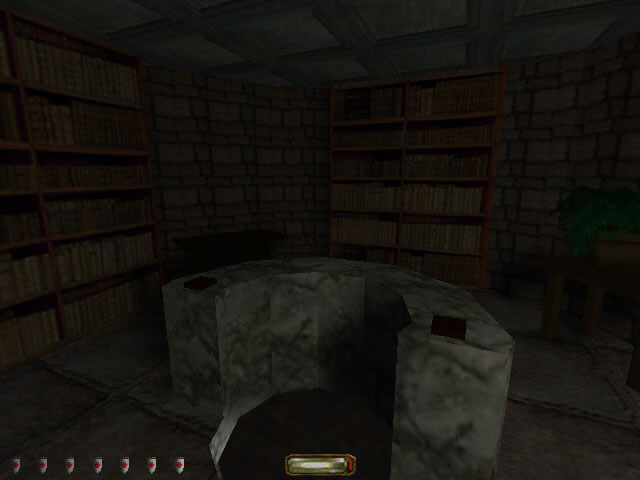
Graphically, the game is gorgeous. Garrett gets to explore many different environments, from the dark city streets to lush mansions to banks to eerie woodland areas. As mentioned above, sound-wise, the game is masterful as well, as every under-the-breath grumble of a just-out-of-sight guard, every footstep on every different type of floor, and every mechanical watchdog add immeasurably to the intense atmosphere of the game.
The game shares another key praiseworthy feature from the first installment. Each mission can be played on Normal, Hard, or Expert level of difficult. However, unlike most games, the increased difficulty settings don’t result in more enemies and less ammo. They simply indicate larger missions. Playing on Expert usually means you can’t kill anyone, and you have more items to find. Well, the idea of not killing anyone lies at the very heart of Garrett’s thief ethos, and makes total sense. Therefore, when you play this game on Expert, you get about 50% more game, not simply a harder game. Take my word for it, forget the Normal and Hard settings.
Despite the very sad fact that the spectacular Looking Glass Studios is no more (thank you, Eidos), it’s an extremely fortunate fact that Thief 3 is currently being developed by Warren Spector’s branch of Ion Storm.
Thief 2 is purely and simply a Hall of Fame title that every computer gamer should experience.
Final Grade: A+
System Requirements:
PII 266
48 MB RAM
4X CD-ROM
3D Accelerator
8MB VRAM
250 MB disk space
mouse, sound card
DirectX v7.0