System Shock
|
Review System Shock Developer: Looking Glass Technologies |
 |
When I was gathering facts for this review (other than playing the game of course), I almost couldn’t believe my eyes when I discovered that System Shock was released in 1994. At that time, the killer game was id Software’s DOOM, technically brilliant yet totally mindless (yes, I played it but I was never a real DOOM addict, I thought it was lacking inventiveness and flair). 2D point and click adventures were perhaps at their height with popular releases like King’s Quest VII or Myst.
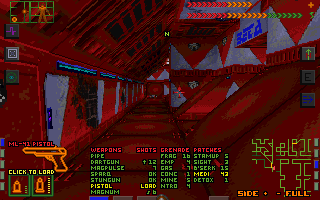
System Shock was very different. Superficially it resembled DOOM with its first person view, but that’s where the similarities ended. System Shock is a game with lots of puzzles and quests, some RPG elements and bits of a story too. The lineage of System Shock can be clearly traced to older games developed by Looking Glass Technologies and published by Origin – the excellent Ultima Underworld I and II. And there were followers too – to name a few, System Shock 2 (naturally) or Deus Ex. The brain behind Deus Ex was Warren Spector who was the producer of System Shock so there’s a link between those games. Warren Spector also participated in the design of System Shock, although – just like with most games – the design of System Shock was a teamwork and it is not possible to name a single person as an “author” of the game. In this particular case the design team was led by Doug Church.
The game starts with a lengthy (for 1994 anyway) animated intro sequence. Sometime in 21st century, an unnamed hacker intrudes into the computer system of TriOptimum Corporation. But he’s not careful enough and soon the TriOptimum goons break down the door of his apartment and apprehend him. But then the hacker is brought in front of a TriOptimum executive Edward Diego and given a choice: he can suffer the punishment for unauthorized network access or he can hack into certain computer system for Diego and if successful, be awarded a neuro graft interface for his services.
Not really having much of a choice, the hacker breaks into the AI of Citadel Station, TriOptimum Corp’s space station orbiting Jupiter. This time the intrusion is successful, no traces are left and the hacker is implanted the promised neural interface. After the operation he has to go into six months long healing coma.
That ends the introduction. Your next task as a player is to set up the game options and this part is very interesting. You can adjust the toughness of enemies, difficulty of puzzles and complexity of the story. System Shock can go from almost pure 3D shooter with bad monsters and linear progress to near adventure game with feeble opponents that are there just for show and many quests requiring lots of running around the space station. I think this variability ensured that System Shock was popular with many kinds of players. I naturally played the version with not too dangerous monsters and most complex quests and toughest puzzles.
The game starts when the hacker – now controlled by you – comes out of his half year sleep. You find yourself on the hospital level of Citadel Station. Unfortunately for you, something has gone horribly wrong. Servant robots are attacking you and the station seems to be overrun by strange mutants. Security systems have gone haywire and have apparently killed all the station personnel.
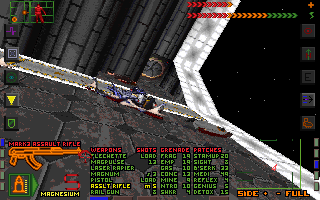
Fortunately some of the ex-staff members have disks with logs on their persons. From these logs you can gradually piece together what happened on Citadel Station in the past weeks and days. Apparently the computer AI, Shodan, has gone mad and completely took over the station. Not just that, Shodan is planning to use the station’s powerful mining laser to attack Earth. Because you might be the last living person on the station, you have to stop Shodan at all costs. Nothing too unusual for adventure gamers – saving the world is practically our daily bread after all. Sometimes you have to wonder if it’s worth all the effort.
To fight your way through the station – or, on the easiest difficulty level, to waltz through the station – you can choose from a variety of weapons. You start armed with just a simple but effective lead pipe and soon find a dart gun, laser blaster or a military pistol. As you progress towards the upper levels of Citadel Station, you find more powerful weapons – pistols, submachine guns, energy weapons and automatic rifles. But of course your enemies will be more powerful too. Fortunately most of them carry some ammunition so there is little danger of running out of bullets.
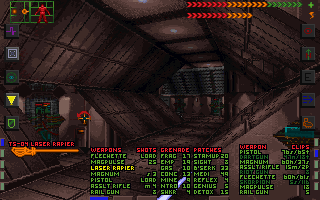
And your new cyber interface comes in handy too. Scattered around the station you find a number of cybernetic gadgets, from simple ones like a compass to really useful things like jump-jet boots or almost impenetrable energy shield. But all these gizmos draw some power – in addition to health you also have battery level. When the juice runs out, all these thingamajigs will stop working – as well as all your energy weapons. Luckily there are power charging stations aboard Citadel and you can also carry several extra batteries for emergency recharging. Still, you have to be careful about your energy consumption. Because of this, I found the energy weapons less useful than the classic guns and rifles.
The interface of System Shock is fairly complex. It is a true 3D game which means that you can look up and down. Hence it is necessary to control the game with both hands, one hand on the mouse for directing the pointer and the other hand on keyboard or joystick for walking around. Nowadays it’s not unusual but it was in 1994 – when I first played System Shock sometime in early 1995, it took me quite a while to get used to the controls.
The level layout is mostly 2D and some levels are rather large and complex. Fortunately your cyber interface includes an automap which is extremely handy. Without it I’d certainly get totally lost. The automap even allows you to make notes in it to mark important places. Enhanced versions of your cybernetic mapping unit include even a scanner/radar that will show you enemies on the map before they see you – very useful.
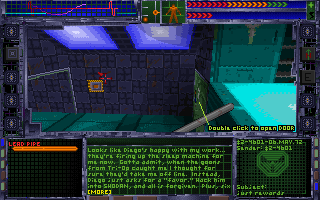
Speaking of enemies, there are several classes of them. There are mutants (purely biological), robots (purely mechanical) and cyborgs (mixed). Different weapons have different effects on them, for instance hollow point bullets or tranquilizer darts are very efficient against mutants but nearly useless against robots. On the other hand, EMP grenades will take out robots easily but have zero effect on mutants. Fortunately you can carry seven weapons at once (plus seven types of grenades, bombs and mines) so it’s easy to choose the right one for every occasion.
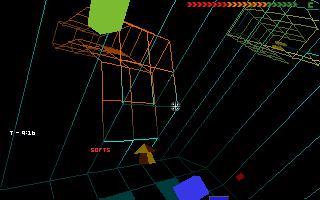
Apart from the “real” environment of Citadel Station, you must also make few trips to the cyberspace which can be accessed from cyber jacks located in several offices. The cyberspace is fully 3D with wireframe “space” – sort of spacious halls interconnected with long tunnels. In cyberspace you have to fight cybernetic guards and collect various data, for instance combat software or data fragments containing access codes. The movement cyberspace is a little confusing because there is no up and down – no gravity you know…
The storyline of System Shock is more complex than one would expect from something that looks like a first person shooter. At first your objective seems quite simple – but Shodan is a worthy opponent whenever you thwart its efforts to take over the Earth, it finds some other and entirely unexpected means to threaten this little planet. Which of course means more fun for you! More quests to fulfill, more dead enemies, that kind of thing.
The art in the game is about what you’d expect in 1994. The game runs in 320×200 resolution with 256 colors which does look rather blocky on today’s big monitors. But of course System Shock didn’t require even a Pentium or a 3D card. There are digitized sound effects and synthesized music – the game supports most sound cards of that time, including SB AWE32. The sounds and music aren’t quite as great as in some Sierra games but certainly not bad. I believe Origin later released a CD version of the game that supported SVGA resolutions and had more sound effects but I only played the original floppy version (you remember floppies don’t you?).
System Shock is a fun game. It is not an adventure game but it contains enough adventure elements to be attractive to fans of that genre. On the other hand at first sight it looks like an action shooter so action gamers might mistakenly play a game that requires more than just eye-hand coordination. The graphics look pixely nowadays but it wouldn’t be fair to compare System Shock with games that require hundred times more horsepower (if only they were hundred times better!). It has distinct atmosphere (when the cyborgs jump at you from the dark it’s really scary!) and the gameplay is very immersive, it is really hard to stop playing once you started. Given all that, I decided to award System Shock a nice and clean A. It is one of the games that will not be forgotten anytime soon.
Final Grade: A
System Requirements:
IBM or 100% compatible 486 or better DOS 5.0 VGA compatible card 4 MB RAM