 |
|
|
 |
|
|
 |
 |
|
 Contents
About Us
Advertising
on JA+
Archives
Articles
Audrey's JA+ Links
CDAccess.com
Eye
on Adventure
Interviews
JA
Forum
JAVE
Letters
Press
Releases
Previews
Recent
Releases
Reviews
Search
Schedule of Upcoming
Releases
Site Map
Walkthroughs
What's New



(Not) Playing the Game
Part 1

The Adventure Begins
For far too long, the few have spoken for the many. There is not one magazine that actively supports the adventure gamer, nor, with the exception of the sites that belong to the Adventure Coalition, are there many webzines that provide unbiased reviews of adventure games. Numerous publishers and public relations personnel agree, off the record of course, that the genre is dead. Public perception, though, seems to have been shaped by a few individuals who, through their misuse of power and dislike of the genre, have convinced others of their prejudices. Yet, for all of their posturing and insistence that no one is playing adventure games, the facts seem to prove otherwise. SouthPeak, Cryo, and DreamCatcher all boast their most impressive adventure line-up in years. In January, Just Adventure had, for the second month in a row, over 1.5 million page impressions from over 25,000 visitors. While I would like to believe that our increased readership is due to my infallible charm, I know that it can instead be attributed to a lack of sources for adventure gaming news--a void that has been validated by the number of adventure gaming sites cropping up to fill it in the past year alone.
To make matters even worse, many distributors and publishers seem to be under the mistaken impression that the biased opinions spouted by these unwanted spokespersons are representative of the industry--and they are not. Almost without exception, membership in every major gaming magazine and webzine staff is limited to Caucasian males in their early twenties and an occasional token Asian-American. Minorities and females are usually nonexistent. This is hardly representative of the gaming community at large, much less adventure gamers. One need look no further than Tom Houston's excellent Profile of an Adventure Gamer to understand that adventure games are one of the few, if not the only, genres that have equal appeal to male and female, black and white, young and old.
Over the course of this four-part series, we will take a look at how the adventure gaming community is mistakenly viewed by the industry from top to bottom: from magazines to webzines; from corporate heads to the average consumer. It is not a pretty picture, and only we, the adventure game enthusiasts, have the power to alter this skewed perspective. We will offer suggestions and radical solutions that will be controversial. We will venture into areas and cross boundaries that have previously been considered taboo. In the end, we hope that we have at least made you think and maybe even enticed you into speaking out on behalf of the beleaguered adventure gamer.
Magazines and Adventure Games
The immediacy of the Web has led to an unprecedented decline in game magazine readership. Subscriptions are at an all-time low. Publishers have fought back by lowering subscription rates and offering exclusives. Still, the special holiday issues this past year were smaller than ever as advertisers began to find more profitable venues in which to spend their money. What has hurt the magazines the most is their refusal to recognize that not all gamers are 20-year-old white males. Very few offer reviews from the perspective of an adventure gamer, much less a woman, a teenager, or a senior citizen. In fact, most reviewers are computer "geeks" or "experts," if you will, who can finish a game in the tenth of the time it takes the average gamer. Thus, their most common complaints about a game being too short, too easy, or too similar to other products really have no validity for the average gamer, who probably only purchases 10 or 12 new games a year compared to the dozens a reviewer plays. If these magazines are still wondering what many of their previous readers have gravitated to, they need look no further than Just Adventure. One industry professional we spoke with offered the following analysis of his relationship with the gaming magazines:
"I wouldn't necessarily blame the publishers with not helping out the adventure genre. In my mind, the publishers are the "suits" and they are required to make business decisions. This makes it that much harder for them to break away from the previous year's hits. Further hampering their ability to branch out is the fact that publishers become branded. The perception of the public that EA is a sports company inhibits their adventure gaming. Sierra had an "adventure" brand, but they sold out ...
"In my mind, the biggest culprits are the magazines, who lambast adventure gaming. Unfortunately, they are very jaded. They are exposed to everything, and are constantly in a "new technology" state of mind. So, [my game] was labeled "old" in style--even though I specifically designed it to be that way. Unfortunately, I get sea sick from most of the 3D games, and I was trying to create a game that others who can't play 3D games can have some fun with. Yes, it is an old style--but it's one I can play! And, I received hundreds of emails from people who loved the game, and many begged me to make more of the same. PC Gamer gave what I considered a fair evaluation, with minor lambasting. PC Games really needled us. But, since PC Gamer bought PC Games, some of the nasty writing staff continued at PC Gamer. The problem is that these guys think they are cool by flaming projects they don't like. Sort of like some of the punks on the web... Oh well ..."
"Oh well" indeed ... and this is just one of many correspondences I have received from industry professionals unhappy with the venomous manner that adventure games are reviewed in the gaming magazines and on the web. For understandable reasons, they have all asked to remain anonymous.
 Next
Generation: Pseudo-intellectual claptrap for the immature gamer.
It is suspicious when a magazine allots four pages to a preview of a game
and half a page to a review of the finished product. Finding an adventure
game review, much less a female writer, in Next Generation is like
looking for a needle in a haystack. The staff seems more concerned with
the hardware necessary to play the game and whether or not it is cutting-edge
than they are with the depth or complexity of the gameplay. (A typical
line from an NG review: "The graphics have undergone a serious
technological update and have been remarkably improved although over-reliance
on a single texture in a few scenes induces a relative monotony.")
As they have no steady adventure reviewer, their opinions are usually
across-the-board--almost universally--negative. A review of Gabriel
Knight 3 by Jeff Lundrigan, one of the few NG reviewers who
is consistent in his opinions, gave it four out of five stars. More common
are the reviews awarding Cryo's Ring one star and a three-star
review of the Playstation adventure game Juggernaut. The opening
line is consistent with the perceived overall opinion of NG toward
adventure games, "Juggernaut is a game that most hard-core
gamers should probably avoid. It lacks any action, and the graphics are
merely passable. It favors thinking over reflexes ..." Well,
duh! While Next Generation does a passable job in some areas, it
is not recommended for adventure gamers and receives a grade of F.
Next
Generation: Pseudo-intellectual claptrap for the immature gamer.
It is suspicious when a magazine allots four pages to a preview of a game
and half a page to a review of the finished product. Finding an adventure
game review, much less a female writer, in Next Generation is like
looking for a needle in a haystack. The staff seems more concerned with
the hardware necessary to play the game and whether or not it is cutting-edge
than they are with the depth or complexity of the gameplay. (A typical
line from an NG review: "The graphics have undergone a serious
technological update and have been remarkably improved although over-reliance
on a single texture in a few scenes induces a relative monotony.")
As they have no steady adventure reviewer, their opinions are usually
across-the-board--almost universally--negative. A review of Gabriel
Knight 3 by Jeff Lundrigan, one of the few NG reviewers who
is consistent in his opinions, gave it four out of five stars. More common
are the reviews awarding Cryo's Ring one star and a three-star
review of the Playstation adventure game Juggernaut. The opening
line is consistent with the perceived overall opinion of NG toward
adventure games, "Juggernaut is a game that most hard-core
gamers should probably avoid. It lacks any action, and the graphics are
merely passable. It favors thinking over reflexes ..." Well,
duh! While Next Generation does a passable job in some areas, it
is not recommended for adventure gamers and receives a grade of F.
 PC
Gamer: Would only be worth its cover price if it was printed on
toilet paper and could thus serve its real purpose. Probably the single
biggest negative influence in the perpetuation of the myth that adventure
games are dead. Adventure games are all but ignored. I wish I could share
with you the private emails I have received from adventure game developers
swearing that they will never again send a product for review to these
butchers. Some of their staff seem to operate under the impression that
criticizing a game for every reason possible without taking into consideration
budget restrictions, first-time developers, etc., is providing a boon
to the industry when in reality it is decimating smaller companies that
rely on reviews to push sales and generate operating income. A recent
review of Amerzone awarded the game a score of 20% (out of a possible
100), complained of the "disjointed storyline," and, in a coup
for international relations, scornfully claimed that Amerzone is
akin to "being trapped in the middle of a brain-addled French-man's
drug fantasy." The same magazine, though, never seems to have a problem
with the disjointed storylines of games like Duke Nukem, Quake, or
Unreal. In fact, their reviewing policy seems to be, "If it's
an adventure game--scorn it. If it's by a small company--ridicule it.
If it's by a major publisher--kiss their asses (gotta keep those companies
with big advertising budgets happy)." A recent review of Ultima
IX, a game that has been rightfully blasted by every major magazine
and webzine for being released unfinished, was given a score of 80% by
PC Gamer, who insisted that "it's brilliance as a game ultimately
outshines and overshadows any of these failings." If this same bug-ridden,
multiple-patched travesty had been released by anyone other than Electronic
Arts and Lord British, I assure you that the score would have been halved.
This is a magazine where the staff is more interested in positioning themselves
for a high-paying career with a high-profile company in the industry than
they are making waves by being truthful. When the integrity of the reviews
and reviewers is in question, then it becomes understandable why smaller
developers will no longer submit their products for perusal. Finally,
a monthly column titled "Alternate Reality" purports to focus
on adventure and role-playing games, yet it has trumpeted that the adventure
genre is dead. When furious emails listing dozens of adventure games in
production were received, a printed apology claimed to not of heard of
any of them. Excuse me, but isn't it part of your responsibility as an
adventure columnist at a major magazine to get off your ass and do some
research? I would be remiss if I did not mention that yes, Just Adventure
was promised to be mentioned in the Alternate Reality column. Not only
did this never happen (and probably never will now!), but emails inquiring
as to the change in attitude have gone unanswered. Definitely not recommended
for adventure gamers; final grade--F.
PC
Gamer: Would only be worth its cover price if it was printed on
toilet paper and could thus serve its real purpose. Probably the single
biggest negative influence in the perpetuation of the myth that adventure
games are dead. Adventure games are all but ignored. I wish I could share
with you the private emails I have received from adventure game developers
swearing that they will never again send a product for review to these
butchers. Some of their staff seem to operate under the impression that
criticizing a game for every reason possible without taking into consideration
budget restrictions, first-time developers, etc., is providing a boon
to the industry when in reality it is decimating smaller companies that
rely on reviews to push sales and generate operating income. A recent
review of Amerzone awarded the game a score of 20% (out of a possible
100), complained of the "disjointed storyline," and, in a coup
for international relations, scornfully claimed that Amerzone is
akin to "being trapped in the middle of a brain-addled French-man's
drug fantasy." The same magazine, though, never seems to have a problem
with the disjointed storylines of games like Duke Nukem, Quake, or
Unreal. In fact, their reviewing policy seems to be, "If it's
an adventure game--scorn it. If it's by a small company--ridicule it.
If it's by a major publisher--kiss their asses (gotta keep those companies
with big advertising budgets happy)." A recent review of Ultima
IX, a game that has been rightfully blasted by every major magazine
and webzine for being released unfinished, was given a score of 80% by
PC Gamer, who insisted that "it's brilliance as a game ultimately
outshines and overshadows any of these failings." If this same bug-ridden,
multiple-patched travesty had been released by anyone other than Electronic
Arts and Lord British, I assure you that the score would have been halved.
This is a magazine where the staff is more interested in positioning themselves
for a high-paying career with a high-profile company in the industry than
they are making waves by being truthful. When the integrity of the reviews
and reviewers is in question, then it becomes understandable why smaller
developers will no longer submit their products for perusal. Finally,
a monthly column titled "Alternate Reality" purports to focus
on adventure and role-playing games, yet it has trumpeted that the adventure
genre is dead. When furious emails listing dozens of adventure games in
production were received, a printed apology claimed to not of heard of
any of them. Excuse me, but isn't it part of your responsibility as an
adventure columnist at a major magazine to get off your ass and do some
research? I would be remiss if I did not mention that yes, Just Adventure
was promised to be mentioned in the Alternate Reality column. Not only
did this never happen (and probably never will now!), but emails inquiring
as to the change in attitude have gone unanswered. Definitely not recommended
for adventure gamers; final grade--F.
 Computer Gaming World: At one time, the voice of the adventure
gamer, but the defections of Johnny Wilson and Scorpia have lessened the
overall appreciation for the genre. The new adventure columnist, Desslock,
may be a proponent of the genre, but we might never know--all he ever
writes about and reviews are RPGs. The adventure reviews in CGW are
still some of the best-written in the business, and their insistence on
playing a game to completion and not considering game patches in the final
review score is admirable, but CGW is also guilty of not making
an effort to seek out anything outside of the mainstream. The adventure
games they do review receive a fair and insightful treatment, and they
often offer solutions to improve a game that does not meet their standards.
Unfortunately, they are also guilty of the same indiscretions as their
contemporaries, an all-male, all-white staff. In a nice change of pace,
though, some of their staff members are old enough to be the parents of
the staff at NG and PC Gamer. Jeff Green's monthly column
alone is often worth the price of admission, and his reviews of adventure
and action/adventure games are usually right on the mark. While Computer
Gaming World is still a viable option for adventure gamers, something
tells me that the glorious ride is almost over, as the new editorial staff
of CGW seems to be veering into a new direction. Recommended with
reservations; grade of C.
Computer Gaming World: At one time, the voice of the adventure
gamer, but the defections of Johnny Wilson and Scorpia have lessened the
overall appreciation for the genre. The new adventure columnist, Desslock,
may be a proponent of the genre, but we might never know--all he ever
writes about and reviews are RPGs. The adventure reviews in CGW are
still some of the best-written in the business, and their insistence on
playing a game to completion and not considering game patches in the final
review score is admirable, but CGW is also guilty of not making
an effort to seek out anything outside of the mainstream. The adventure
games they do review receive a fair and insightful treatment, and they
often offer solutions to improve a game that does not meet their standards.
Unfortunately, they are also guilty of the same indiscretions as their
contemporaries, an all-male, all-white staff. In a nice change of pace,
though, some of their staff members are old enough to be the parents of
the staff at NG and PC Gamer. Jeff Green's monthly column
alone is often worth the price of admission, and his reviews of adventure
and action/adventure games are usually right on the mark. While Computer
Gaming World is still a viable option for adventure gamers, something
tells me that the glorious ride is almost over, as the new editorial staff
of CGW seems to be veering into a new direction. Recommended with
reservations; grade of C.
 Incite--PC
Gaming: The new kid on the block with the potential to be one
of the best. February's editorial featured editor-in-chief Tasos Kaiafas
pontificating about his love for the relaxing pace of adventure games.
Senior editors Gary Eng Walk and Nikki Douglas are both excellent adventure
and action/adventure reviewers. Nikki is one of the few female adventure
game reviewers in the industry, outside of Just Adventure and some other
members of the Adventure
Coalition, and her in-depth and insightful reviews are proof of why
adventure gamers need more spokespersons other than 20-year-old, middle-class,
white males who have only been exposed to action and sports games. Recent
reviews awarded Ultima IX 2 stars (out of a possible 5), Omikron
4 stars, Star Trek: Hidden Evil 2 stars, and Wild, Wild
West 1 star. Every review, even the negative ones, is intelligently
presented and offers suggestions for improvement. None of the typical
"this game sucks because it is an adventure game" crap so familiar
to Gamespot and PC Gamer readers. Previews are actually shorter
than the reviews, so we do not get the impression that the writers are
paid shills for the distributors. Did I mention that, besides a female
writer, the staff also has two Asian-Americans, an African-American, and
a few members pushing 30! This is what balanced journalism is supposed
to be, and this balance is why Incite--PC Gaming spurred my decision
to cancel my subscriptions to PC Gamer and Next Generation.
The last two issues have also enclosed playable CD demos of Indiana
Jones, Gabriel Knight 3, and Star Trek: Hidden Evil. Make sure
you don't pick up a copy of Incite--Video Gaming by accident (a
fine magazine in its own right). Let's hope they keep up the good work
and don't fall prey to the almighty advertising dollar. Recommended for
adventure gamers; grade of B+.
Incite--PC
Gaming: The new kid on the block with the potential to be one
of the best. February's editorial featured editor-in-chief Tasos Kaiafas
pontificating about his love for the relaxing pace of adventure games.
Senior editors Gary Eng Walk and Nikki Douglas are both excellent adventure
and action/adventure reviewers. Nikki is one of the few female adventure
game reviewers in the industry, outside of Just Adventure and some other
members of the Adventure
Coalition, and her in-depth and insightful reviews are proof of why
adventure gamers need more spokespersons other than 20-year-old, middle-class,
white males who have only been exposed to action and sports games. Recent
reviews awarded Ultima IX 2 stars (out of a possible 5), Omikron
4 stars, Star Trek: Hidden Evil 2 stars, and Wild, Wild
West 1 star. Every review, even the negative ones, is intelligently
presented and offers suggestions for improvement. None of the typical
"this game sucks because it is an adventure game" crap so familiar
to Gamespot and PC Gamer readers. Previews are actually shorter
than the reviews, so we do not get the impression that the writers are
paid shills for the distributors. Did I mention that, besides a female
writer, the staff also has two Asian-Americans, an African-American, and
a few members pushing 30! This is what balanced journalism is supposed
to be, and this balance is why Incite--PC Gaming spurred my decision
to cancel my subscriptions to PC Gamer and Next Generation.
The last two issues have also enclosed playable CD demos of Indiana
Jones, Gabriel Knight 3, and Star Trek: Hidden Evil. Make sure
you don't pick up a copy of Incite--Video Gaming by accident (a
fine magazine in its own right). Let's hope they keep up the good work
and don't fall prey to the almighty advertising dollar. Recommended for
adventure gamers; grade of B+.
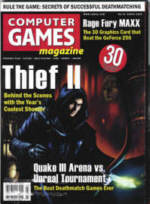 Computer
Games Magazine: An adventure lover's Disneyland. A monthly column
by Cindy Yans--yes, another female reviewer--that actually focuses on
adventure games. Previews of European adventure games like It Came
from Zog. Articles like "The 10 Best Adventure Games." Informative
reviews by Tom Chick, Jason Cross, and the two Cindys--Yans and Vanous.
Even the articles and reviews that cover other genres usually focus on
the cerebral and strategy facets of the gaming experience. The only gaming
magazine besides Incite to boast more content than advertisements. Editor-in-chief
Denny Atkin has a solid background in the gaming industry, and it shows.
Computer Games Magazine does not try to impress with flashy pictures
and fancy unintelligible jargon, but instead offers a solid, balanced
presentation of all the genres. Kudos to the entire staff. If you have
not already subscribed, what are you waiting for? Highly recommended for
all adventure gamers; grade of A+.
Computer
Games Magazine: An adventure lover's Disneyland. A monthly column
by Cindy Yans--yes, another female reviewer--that actually focuses on
adventure games. Previews of European adventure games like It Came
from Zog. Articles like "The 10 Best Adventure Games." Informative
reviews by Tom Chick, Jason Cross, and the two Cindys--Yans and Vanous.
Even the articles and reviews that cover other genres usually focus on
the cerebral and strategy facets of the gaming experience. The only gaming
magazine besides Incite to boast more content than advertisements. Editor-in-chief
Denny Atkin has a solid background in the gaming industry, and it shows.
Computer Games Magazine does not try to impress with flashy pictures
and fancy unintelligible jargon, but instead offers a solid, balanced
presentation of all the genres. Kudos to the entire staff. If you have
not already subscribed, what are you waiting for? Highly recommended for
all adventure gamers; grade of A+.
So has anything been proven here? It certainly seems clear that the magazines with the younger, Caucasian male staffs have a disposition to attack adventure games and embrace action games. No surprise there, but one would wonder why a company would not want to present a more balanced blend of writers in order to attract more readers. We have not even mentioned the magazines (mostly console-oriented) that offer grade school-level writing and reviews with grades of "wowzer" and "way cool." Granted, these console magazines are skewed toward a younger audience, but what is disturbing is that these magazines are also exclusively comprised of all-male, adventure-hating staff members who will grow up to shape and influence opinions at their future workplaces.
One thing I would question are the qualifications of some of these journalists. In a lot of cases, writing classes would be more than welcome. Next Generation seems to have a fondness for technical jargon and a hatred of any gaming function requiring brain cells. PC Gamer's "holier than thou" attitude and disdain for any game that is not high-budget speaks volumes. One gets the opinion that many magazine reviews are written not to inform a potential customer of the positives or negatives of a game but to showcase how whimsical a particular reviewer can be without actually forming an opinion that could unduly affect his future job options. Fortunately, the majority of the magazine customers are already hardcore gamers and have their purchasing decisions made before they read the critics. What is bothersome, though, is that any outsider or someone new to the industry would read one of the adventure-hating reviews and buy into its venom without being aware of the prejudices that influenced such a negative opinion. This is why we must fervently hope that the future generations of adventure gamers are looking to other sources for their information.
Are there any possible solutions? Well, you will have to wait until part 4 of this article for those, but in the meantime, be here next week for part 2 as we look at gaming webzines and their approach to adventure games.