Review: Sanity: Aiken’s Artifact
|
Developer: Monolith Productions By Erik Reckase 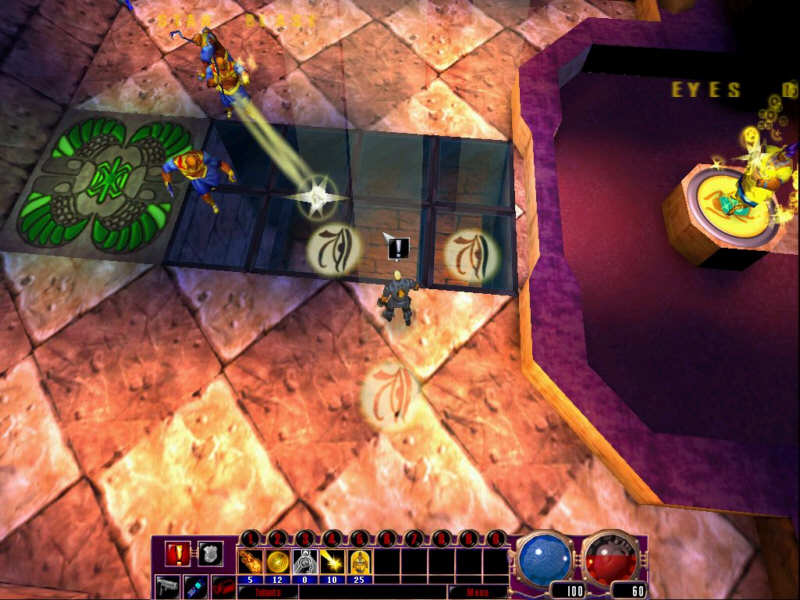 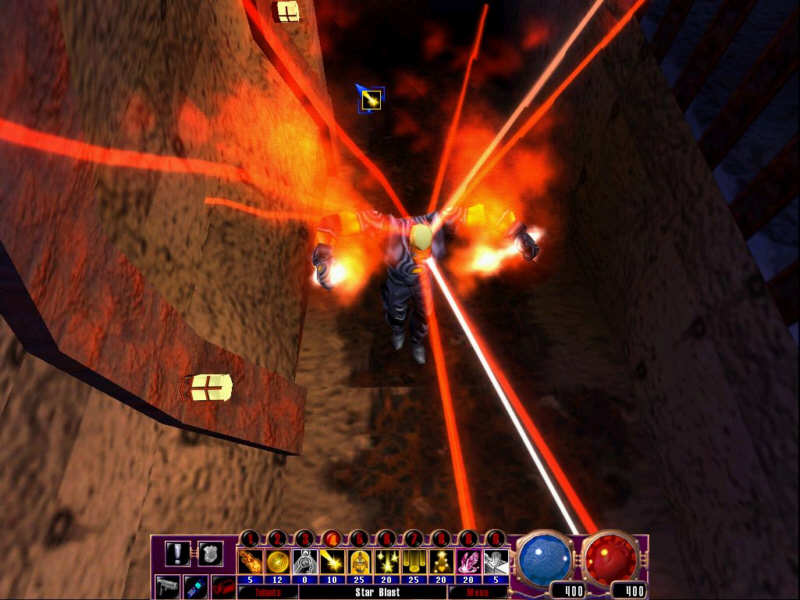 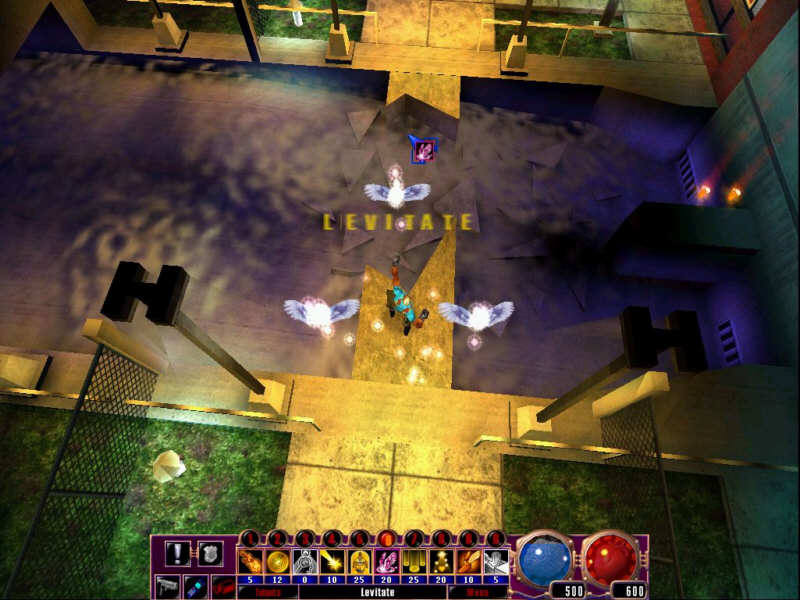 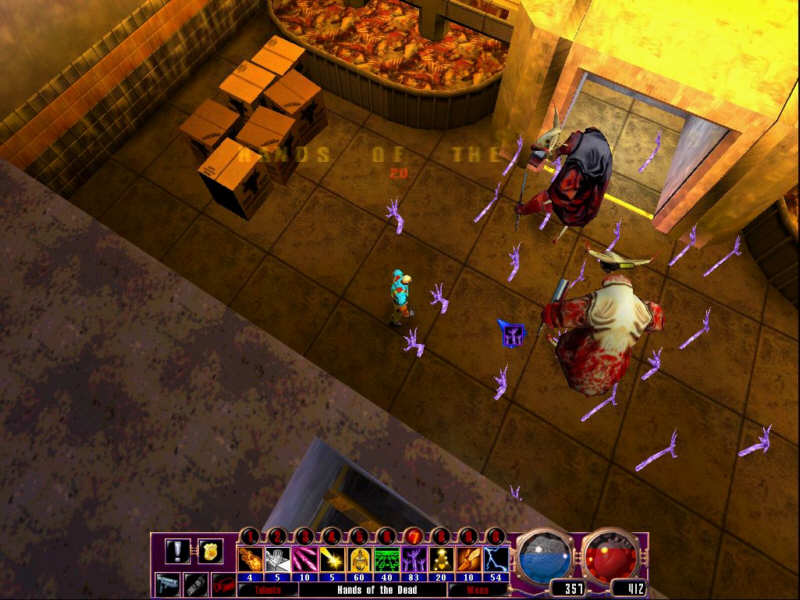 |
It seems like it’s been a quiet summer this year for hybrid adventure gamers. Granted, there have been some very notable releases, like Deus Ex and Baldur’s Gate II, and the Blair Witch Project series looks promising … but other than these (and I’m intentionally leaving out Diablo II), there hasn’t been much to browse in this pre-PSX2 atmosphere. When I saw the advertising for Sanity: Aiken’s Artifact, I hoped that the adventure aspects of the game would be interesting enough to properly complement the action sequences. Unfortunately, although Sanity is surprisingly satisfying from an adventure aspect, the game’s poor controls and horrible load times eliminate most of the fun in this game.
What’s Going on Here?
Sanity really surprised me with the depth of the plot and the quality of the story told. In the year 2028, a mysterious artifact was unearthed in the Middle East. Dr. Joan Aiken, a genetic scientist, was able to create a serum from the artifact that allowed people to access the unused portions of the human brain, giving the recipients powerful Psionic abilities. Unfortunately, fully developed adult brains were unable to adapt to the effects of the serum, and all of the patients eventually went insane. To eliminate this problem, Dr. Aiken developed a procedure that gave in-utero babies the serum while their minds were developing. This was a nearly perfect solution; the first two test subjects, Cain and Abel, were far more resilient to the debilitating effects of Psionic abilities, although they also ran the risk of insanity if these abilities were overextended (hence the title).
The government, fearing the evolution of a race of “super criminals” through the use of the Psionic Booster Serum, created the Department of National Psionic Control (DNPC). This organization’s goal was to fight these Psionic criminals with a Psionic government agents–and who better to recruit for the job than Cain and Abel? Unfortunately, the brothers would not have the easiest careers. After a few years on the force, Abel became egotistic and focused more on Psionic combat techniques than upholding the law, and he was suspended from the force. He escaped the DNPC detention center and turned to a life of crime. Cain, on the other hand, remained on the force, but he was involved in an unfortunate incident resulting in the death of numerous innocent civilians. To remain on the force but prevent a similar tragedy from happening again, Cain agreed to receive an implant that would shut him down in the event that any hostility was directed toward an innocent person.
You begin the game after the implant procedure. As an agent of the DNPC, you are sent on a series of missions to apprehend Psionic criminals and bring them to justice. As you progress, you become aware of a greater, more insidious plot … but I’ll leave that to you to discover. As a Psionic, you will obtain abilities through the discovery of tarot-like cards called Talents. There are eighty Talents in eight different disciplines, or Totems, that you can discover in the single-player game. Each Talent, when used, will reduce your sanity a small amount while having some effect on you, the environment, or your enemies. (It’s basically spell-casting with a limited amount of mana, but with a sci-fi twist.) This is a good science fiction story, with plenty of opportunities for further plot development through the different characters you meet in the game.
Overall Plot Grade: A
How Did it Sound?
Fans of Ice-T should skip this paragraph. I don’t know who made the decision to use Ice-T as the voice of Cain, but he/she should be fired. Actually, Ice-T should have been fired once the audio folks at Monolith/Fox heard the first hour of recorded dialogue. I’m not exaggerating–it’s truly terrible. It’s as if he had no idea how to act or how to recite lines of dialogue, or he was too whacked out to read the lines properly. Maybe he was sleepy? Regardless, he can’t be blamed for all of the dialogue problems in Sanity; the writers are also to blame. In the first two hours of gameplay, I found three instances of incorrect word usage; for example, after being informed of the current situation regarding a Psionic criminal, Cain gets out of the car and starts walking down the street. His cellular phone rings, and he begins a conversation with his Psionic controller (she keeps tabs on him and helps him out in the field). She asks him, “Have you been debriefed yet?’ Debriefed? Cain hasn’t been told to keep national secrets to himself under penalty of law and also was not grilled by other DNPC agents about his experiences in the last mission, so debriefed is not the correct word. Briefed is the word you’re looking for, guys, so get a dictionary. After the last of these errors, I decided to pretty much ignore the dialogue, which is unfortunate, given the quality of the plot. This is not to say that all of the voice acting is bad, as there are a few characters (unfortunately, minor characters with only one or two scenes) that are well-performed; I was particularly fond of the rednecks in the trailer park at the beginning of the game. The vast majority of the characters, though, are poorly acted and scripted.
The other game sounds, however, are very good. The music is a subtle pulse-pounding electronic piece, which not only fills the audio void between sound effects well, but also provides hints to puzzles in the game (you’ll have to play it to understand). The sound effects are also high-quality simulations of how the environment and your Psionic Talents might really sound, with extremely realistic metallic clangs and crackling fire effects. It’s really too bad about the voice acting, since Monolith did such a good job with the effects.
Overall Sound Grade: C
How Did it Look?
Sanity uses the aging LithTech 3D engine for the visuals, although you wouldn’t know that the engine is more than two years old from the look of the game. Most of the action in the game is seen in what I call “modified isometric” format, with the camera above and behind Cain as he moves around. The camera can be moved manually, and the zoom factor can be changed as well. All of the buildings and characters in the game are rendered from this constantly changing perspective, which requires a fairly fast machine and graphics accelerator to render. (I ran Sanity at 800×600 on my P3 500 MHz PC with a 2MB AGP graphics card, and had virtually no problems.) All of the graphics designers working on Sanity must have great color sense, as the game is one of the most colorful experiences I’ve encountered in my gaming career.
Level design is also very good. I’ve played many action/adventure hybrids, and one style of level design that I’m very familiar with is the “change of scale,” where walking around buildings outdoors is set at one scale, and once a building/room is entered, the scale changes to allow more detail inside. Sanity is unique in that the levels are designed as complete architectural scenes, so that when you walk inside a building, the roof simply becomes transparent and you can explore. No change of scale! Impressive.
Overall Graphics Grade: A
Was it Fun?
If playing Sanity was as much fun as looking at Sanity, this game would get an A, even with the dreadful voice acting mentioned above. Unfortunately, Sanity suffers from Poor Control Syndrome, rendering it frustrating at best. What’s the problem with the controls? It’s a little challenging to describe, so bear with me.
Moving Cain in the game is as easy as positioning the cursor over the location you want to approach and holding the right mouse button to run. Simple, right? Well, it’s a little more complicated than that. Unless you’re moving “up” the screen, the camera will move to get a better view of you running to that location and to keep you in the middle of the screen. As the camera moves, so does the location you are pointing at with the mouse, so in order to go to a particular location, you must hold the right mouse button down and track the location of interest with the mouse as it moves. It’s not too difficult, but it takes a little getting used to.
Now, alone, this wouldn’t be a problem. I’ve become accustomed to some pretty strange control configurations in the past (anyone ever play Sentinel Returns?), so figuring this out didn’t take much time. The big hurdle in Sanity is the combat sequences. In addition to controlling where Cain is moving, the cursor also controls where Cain is aiming his Psionic abilities. This leaves us with the following options:
- Stand still, or run towards your opponent, when using offensive Psionic abilities; or
- Use the alternate keyboard controls for moving Cain while using the mouse to aim your Psionic abilities.
The first option is not for the health-conscious, as your opponents tend to have Talents that will easily take you out if you stop moving, and running toward them will inevitably lead to a projectile Talent attack. The second option is better, but don’t forget that the camera moves when Cain moves. This basically means that if you, for example, try to move to the right, you end up running in an arc as opposed to a straight line, and you won’t end up where you think you should. (You do have the option of turning off the automatic camera positioning to resolve this problem, which does result in some field-of-view loss and added command complexity.) Add some environmental hazards, like bottomless pits and ledges, to the battle, as well as the fact that your enemies can fire Psionic talents at you even if they are off the screen (regardless of the zoom factor), and you’ll soon realize that you don’t really want to finish the game.
Even if the battle sequences weren’t so difficult, Sanity falls off the horse when it comes to restoring saved games. When I started the first level, I was greeted with a “Please Wait … Loading” screen that lasted a full minute. Granted, the screen did have a progress bar so that I knew how long I had left to wait, but one of the steps took at least 75% of the wait (you will learn to dread the Lightmaps message)–couldn’t that one have been subdivided to allow more feedback? Since it was only a minute, I figured it was no big deal, and it was initializing the level. The levels are very large, so it makes sense that there is plenty of initialization to do. I played for a while, moved on to the next level, and encountered the same time delay at startup. No big deal, right? Well, I promptly died during one of the initial confrontations with the trailer park rednecks and pressed the QuickLoad button to restore the game. Another minute later, and I realized that it probably should have been called “Not-So-QuickLoad.” The QuickSave function takes about one second to perform, but each time the game is loaded, there’s this ridiculous delay, even if the level being loaded is the same as the one that is currently being played. During some of the harder sequences, I’d play for twenty seconds, die, and reload over and over and over again, wasting a minute each time. Adding that up, I’d say that I sat waiting for games to load for two hours while playing Sanity, and let me tell you, there are very few games that are worth two wasted hours.
If you’ve read this far (and I don’t know why you would, given the problems above), there is a little fun in Sanity, as the puzzles in the game are actually some of the best that I’ve seen in a hybrid game like this one. There are “find the key and open the door” puzzles, but there’s also some great logic and box movement puzzles that kept me challenged for a good thirty-minute stretch. The puzzles are the best part of the gameplay, since you can pretty much guarantee that you won’t have to load the game repeatedly and waste more time.
Overall Gameplay Grade: D
If not for the control issues, Sanity would be a good game that would have many hours of solid gameplay and story development. Instead, Sanity will shortly be relegated to the bargain bins of our favorite computer superstores. If you see it for $10, pick it up, but otherwise, stay far, far away. For those of you who may be interested, Sanity does have a multiplayer deathmatch mode, as well as some also-available-for-just-a-few-dollars-more Talent add-on packs that can be used in the multiplayer games, but somehow I don’t think you care.
Final Grade: C
PC System Requirements: 300 MHz Pentium II
Windows 95/98/2000 with DirectX 7 or later
64 MB RAM
4x CD-ROM
400 MB hard disk space
8 MB Direct3D compatible video card
DirectX compatible 16-bit sound card
Mouse and keyboard